Venture Capital · Relationship Intelligence
Sam: Digital brain for a three-person fund
VCET is a Vermont seed investor and accelerator run end to end by two co-leads who keep the core team at three people or fewer—tracking two funds, 19 portfolio companies, and 130+ mentors across fragmented exports and recall.
Sam unfolded across two phases: a week-long proof of concept (129 of 168 commits) that won the production contract, followed by a scale-to-zero platform running inside VCET's own Google Cloud organization.
Product Scope Evolution
POC Explorer vs. Production Assistant
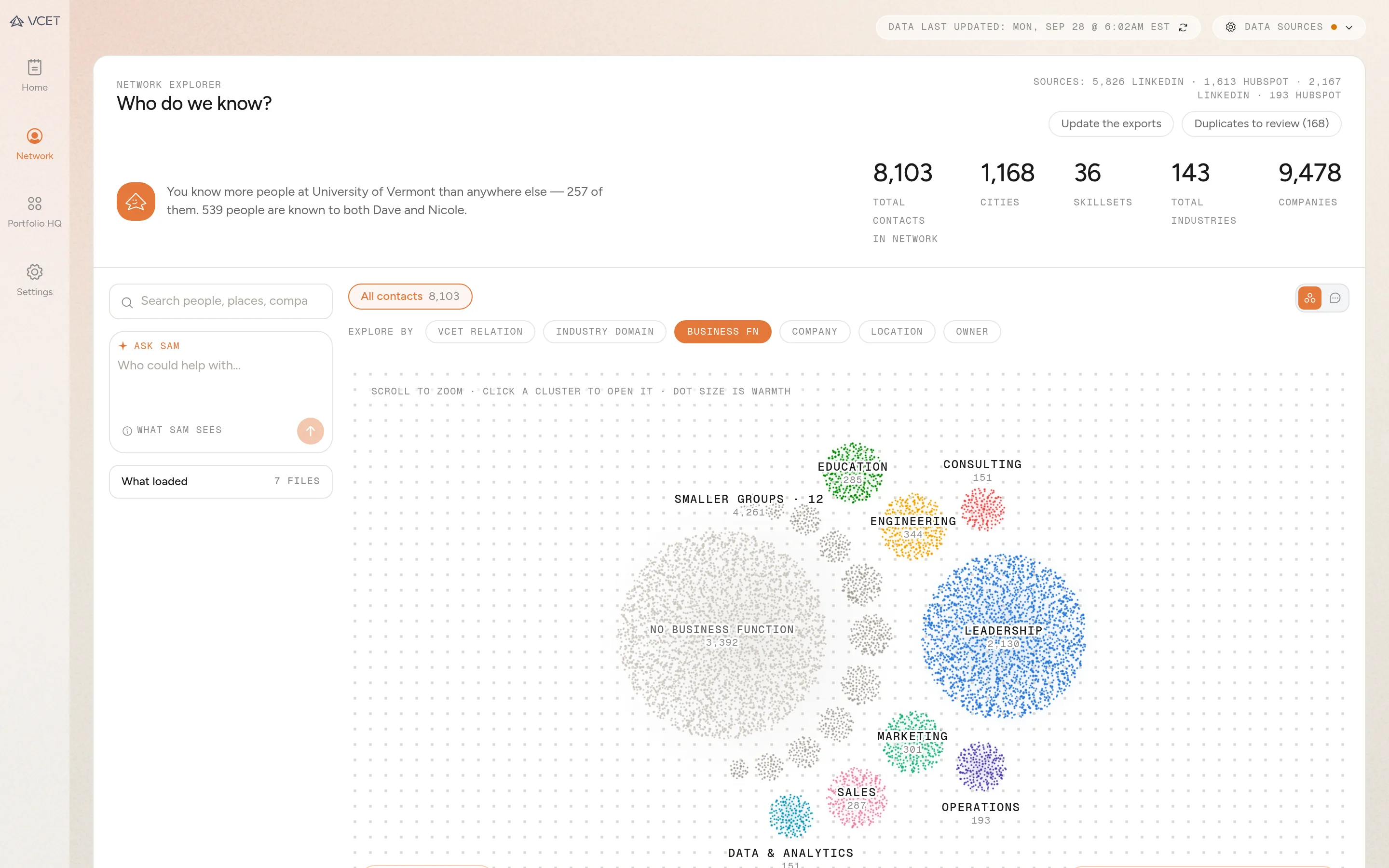
The September 2026 POC proved value fast by turning raw exports into an interactive network explorer and Ask box for VCET's board demo.
Once the production contract landed, discovery showed the co-leads lived in their inbox and calendar—so production put Monday briefings and pre/post-meeting emails first, and Ask second.
- POC (Sep 2026): 129 of 168 commits; interactive Sigma.js explorer + Ask.
- Production (Oct–Nov 2026): Monday brief live 2 Nov, full co-lead launch 18 Nov.
- Owned the model layer: meeting emails, Ask, versioned prompt library, and response healing.
Ask Sam: The model plans, code finds
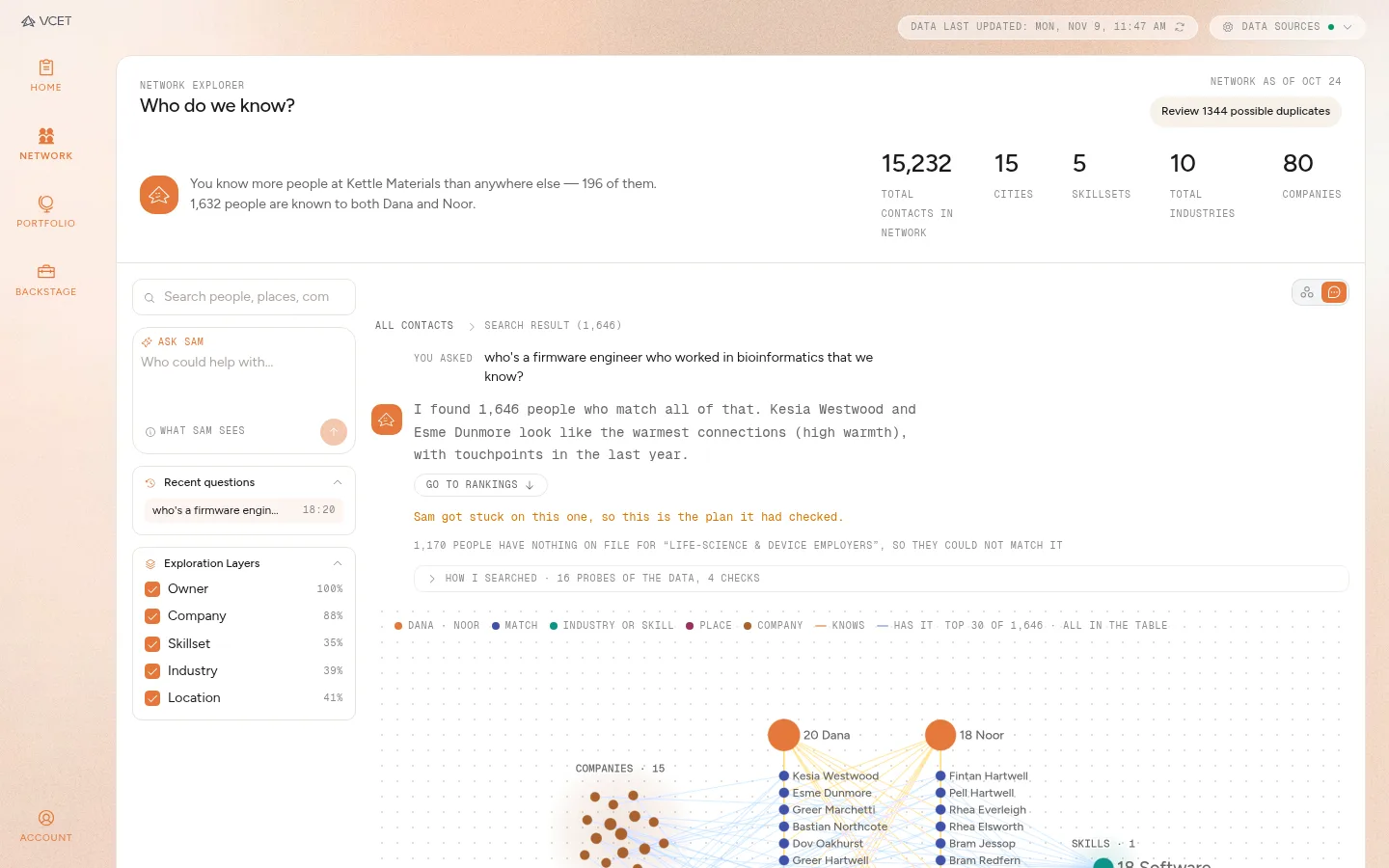
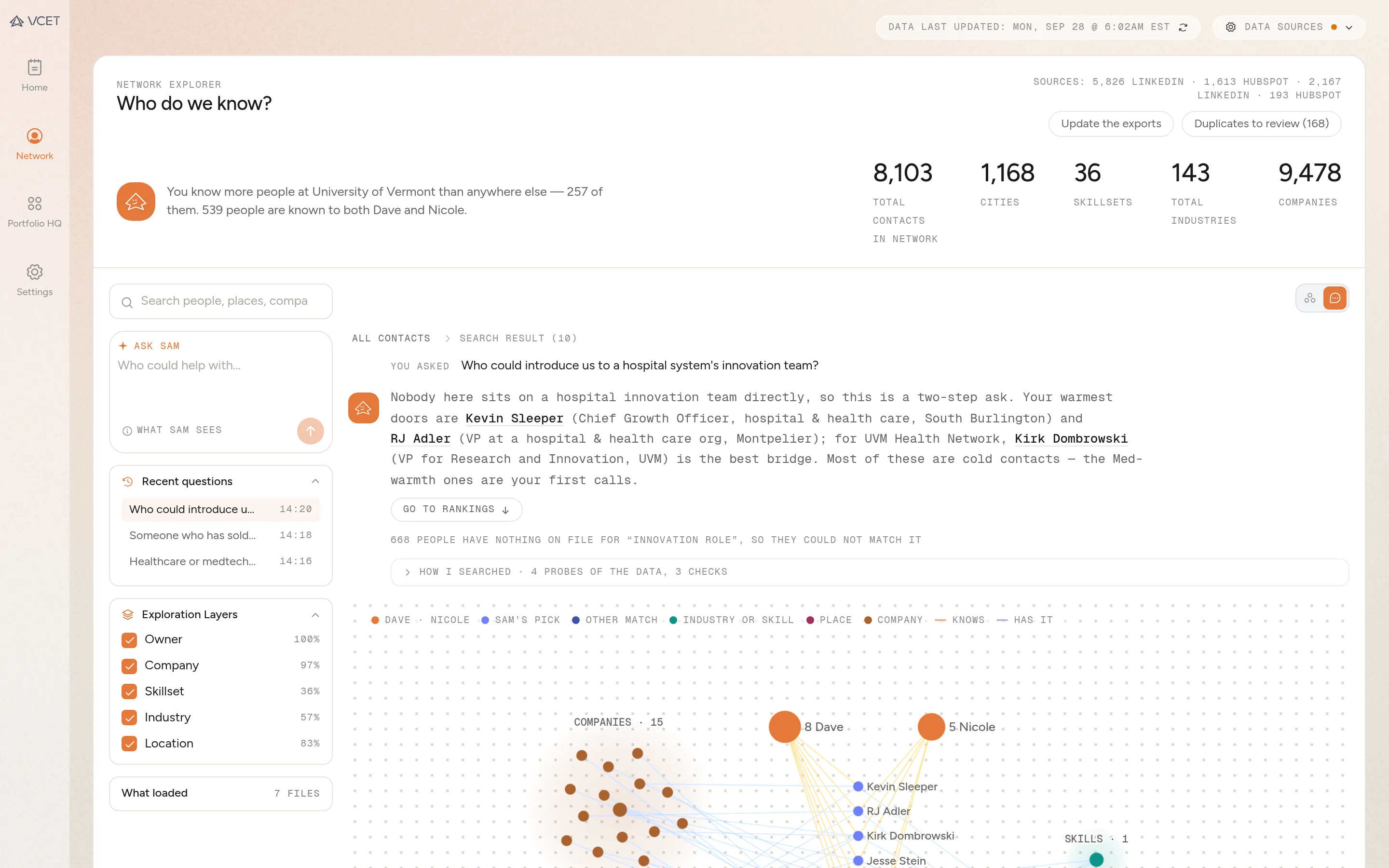
Questions become structured plans over 8 fields marked direct or inferred. The model inspects counts and anonymous rows (r1, r2…), while the browser swaps names back in so personal data never enters the prompt.
Separation of Concerns
Structured plans, anonymous handles, and response healing
Instead of stuffing contact records into context, the LLM outputs a typed plan over 8 fields marked as direct or inferred criteria.
Deterministic tools execute the lookup and return only counts and anonymized row handles (r1, r2…). The browser swaps real names back in locally.
- Code validators reject hallucinated IDs or ungrounded counts.
- Validation failures trigger automatic self-correction (response healing).
- Zero contact names, emails, or personal notes cross the model boundary.
The model never guesses who fits—it writes the search spec, inspects anonymous counts, and explains verified matches.
Agent Runtime: planner loop, guardrails, and healing
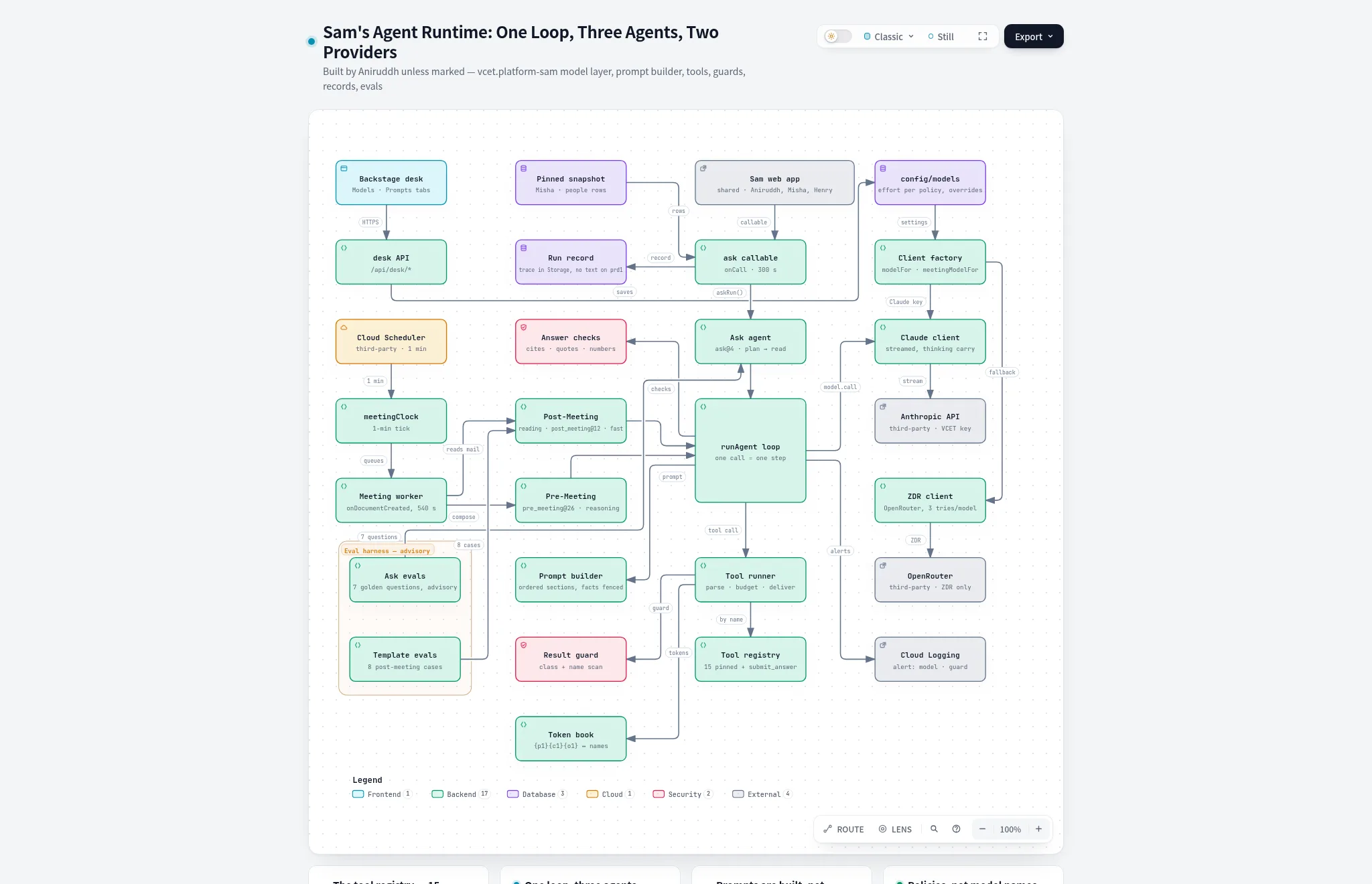
Code-backed Archify diagram of Sam's model layer—covering tool validation, handle anonymization, and response healing.
Explainable Search UI
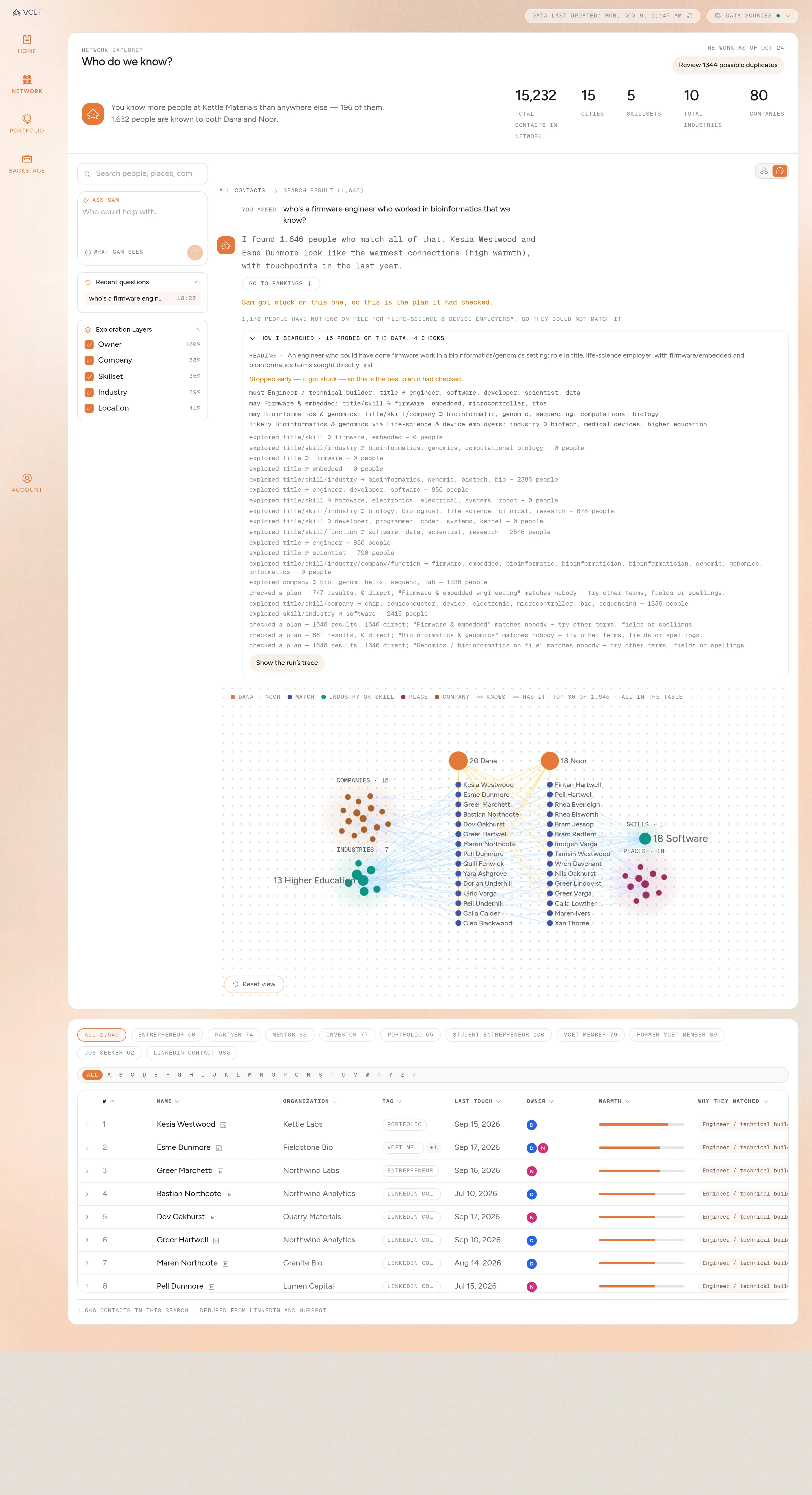
Showing the work under 'How I searched'
Venture partners do not trust opaque recommendations when reaching out to their own network.
Every Ask answer surfaces a collapsible 'How I searched' breakdown distinguishing direct field matches from inferred ('likely') matches—and why an industry match alone never qualifies a person.
- Direct vs. inferred criteria chips match the planner's exact structured output.
- Result counts tie directly back to verified tool outputs.
Resilient State Design
Failure states authored alongside happy paths
Explicit retry banners on backend failures and visible plan traces when Sam gets stuck prevent silent AI dead-ends.
Ask answer lifecycle from loading to settled or stuck
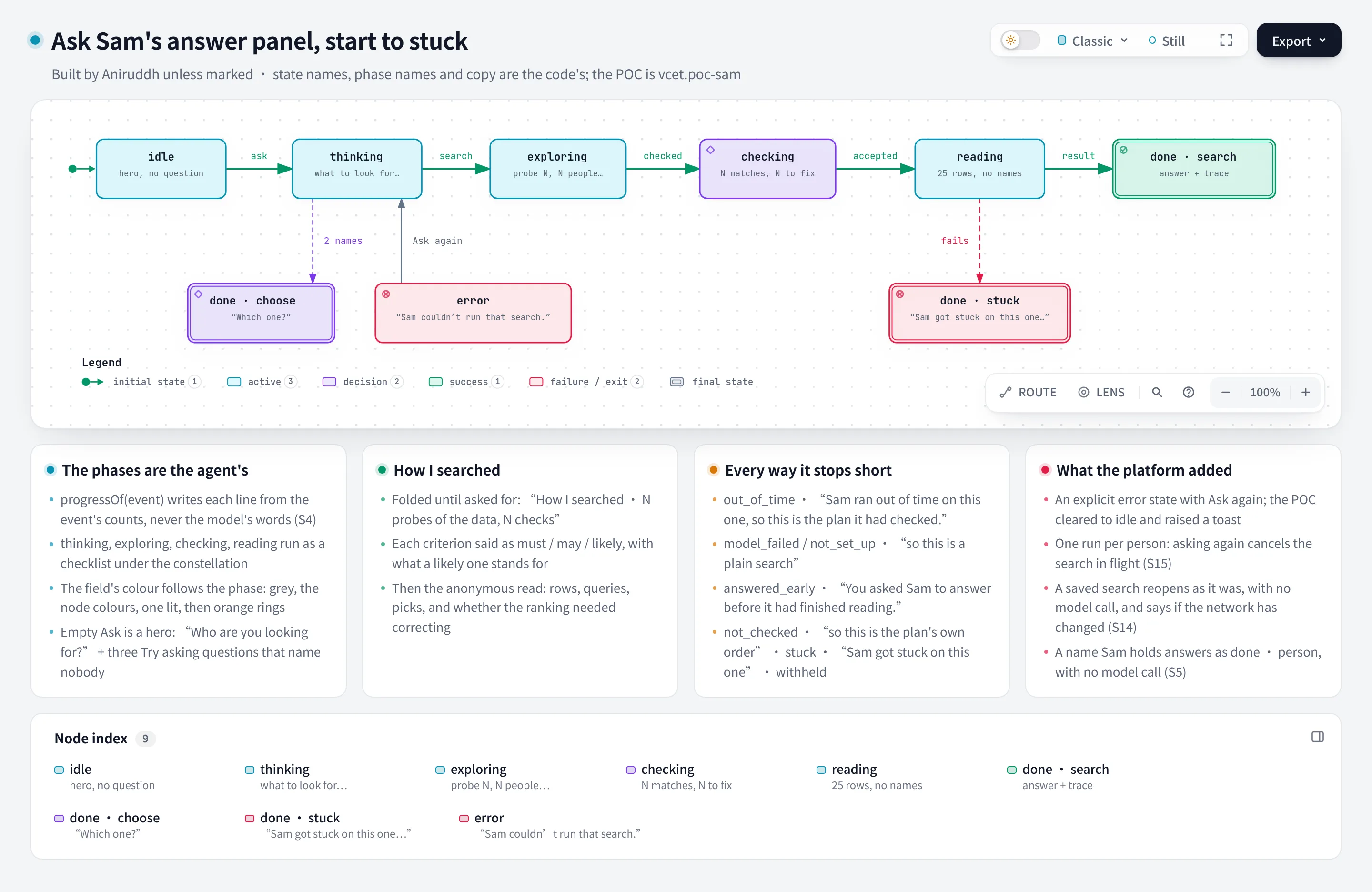
Every transition—streaming criteria, tool execution, healing retries, and explicit stuck states—extracted directly from frontend code.
8,000+ contacts de-duplicated on an interactive canvas
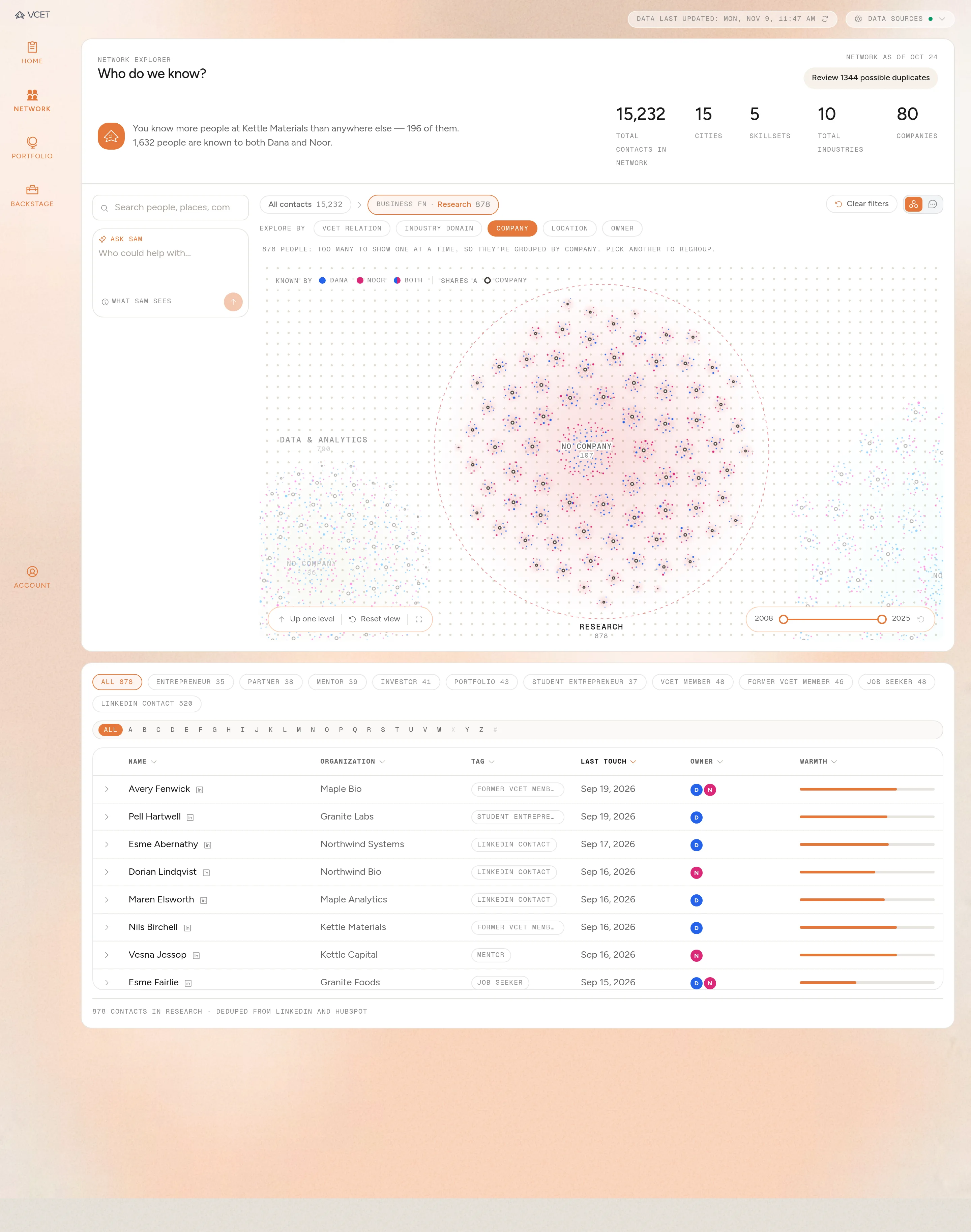
Union-find entity resolution reduced 9,510 noisy rows to 8,010 people and refused risky merges. Sigma + Graphology render pre-flattened rows so filter chips respond immediately.
Evidence-Driven Cleanup
Counts-only merge-audit harness with zero leak guard
Before rewriting a single entity-resolution rule in vcet.poc-sam, I wrote a counts-only merge-audit harness with a guard that failed on any value leak.
Every rule change was justified strictly by aggregate diagnostics rather than eyeballing client contact rows.
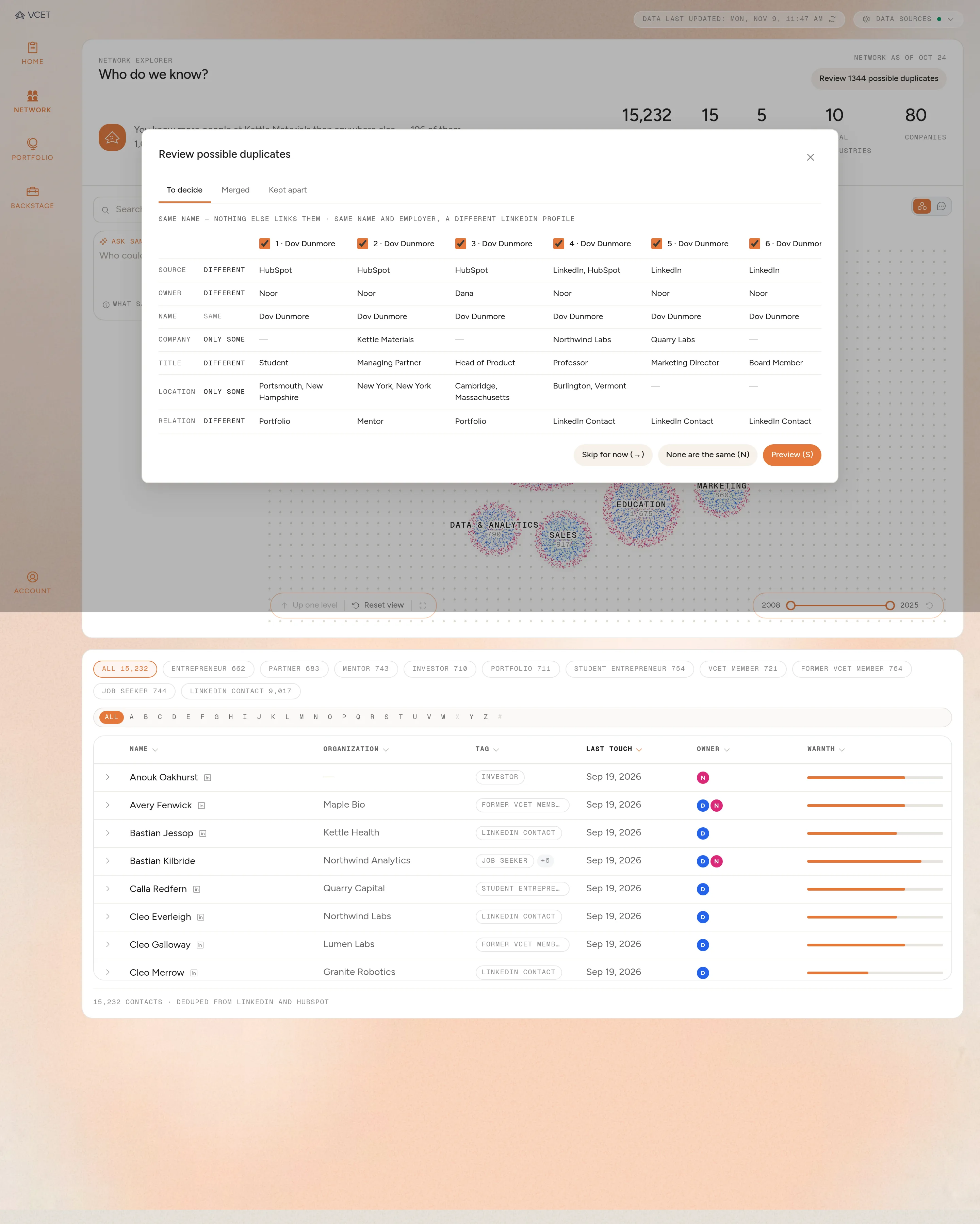
Human-in-the-Loop Ambiguity
Refusing risky merges as a first-class UI state
When two LinkedIn profiles might overlap—common names, outdated employers, missing emails—silent auto-merging corrupts relationship history.
Union-find resolution explicitly declined ambiguous merges and surfaced suspected duplicate groups in a dedicated review flow.
- Conservative auto-merge only on deterministic identity signals.
- Ambiguous pairs queued as reviewable merge groups.
Weekly briefings and meeting nudges inside VCET's org
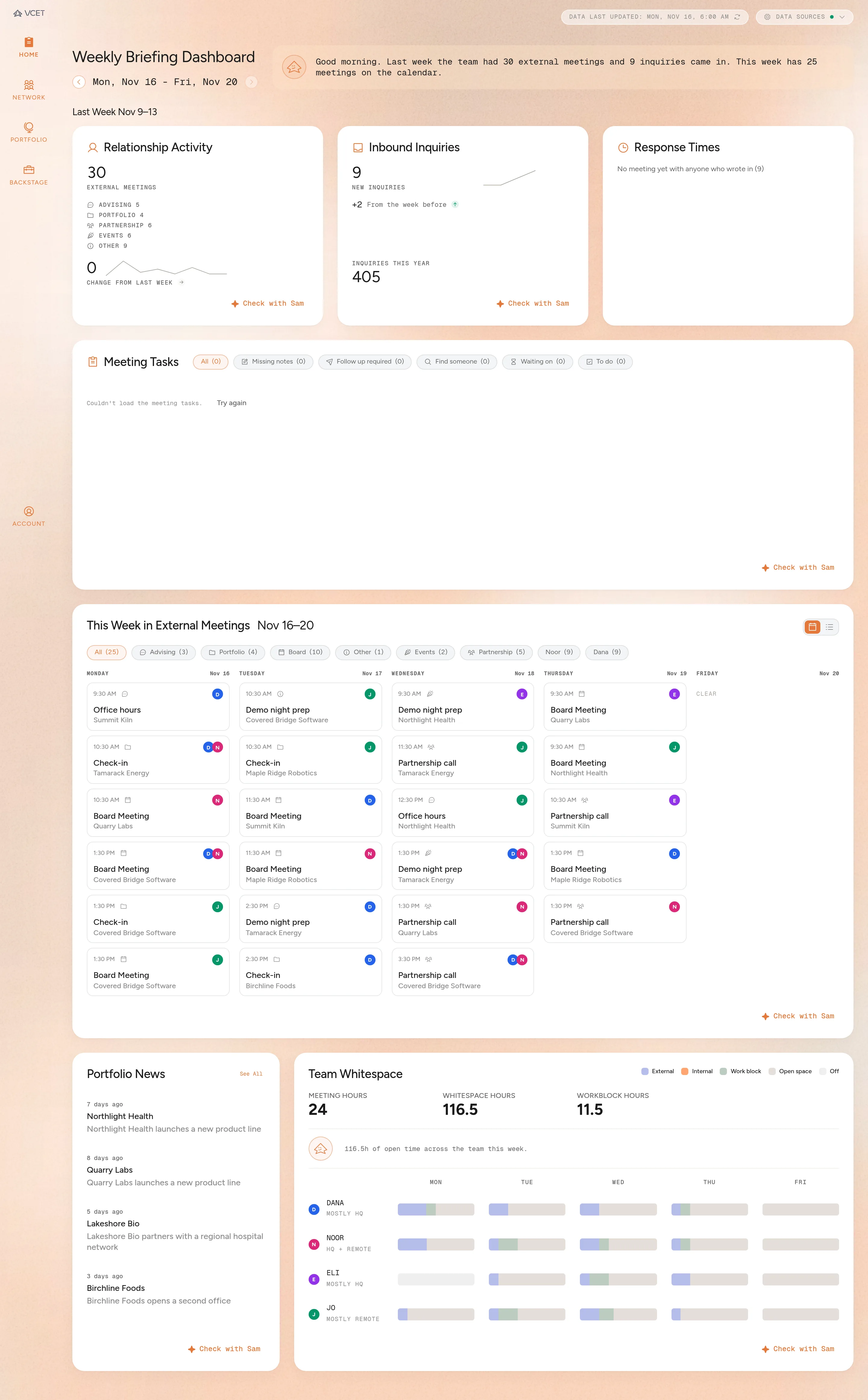
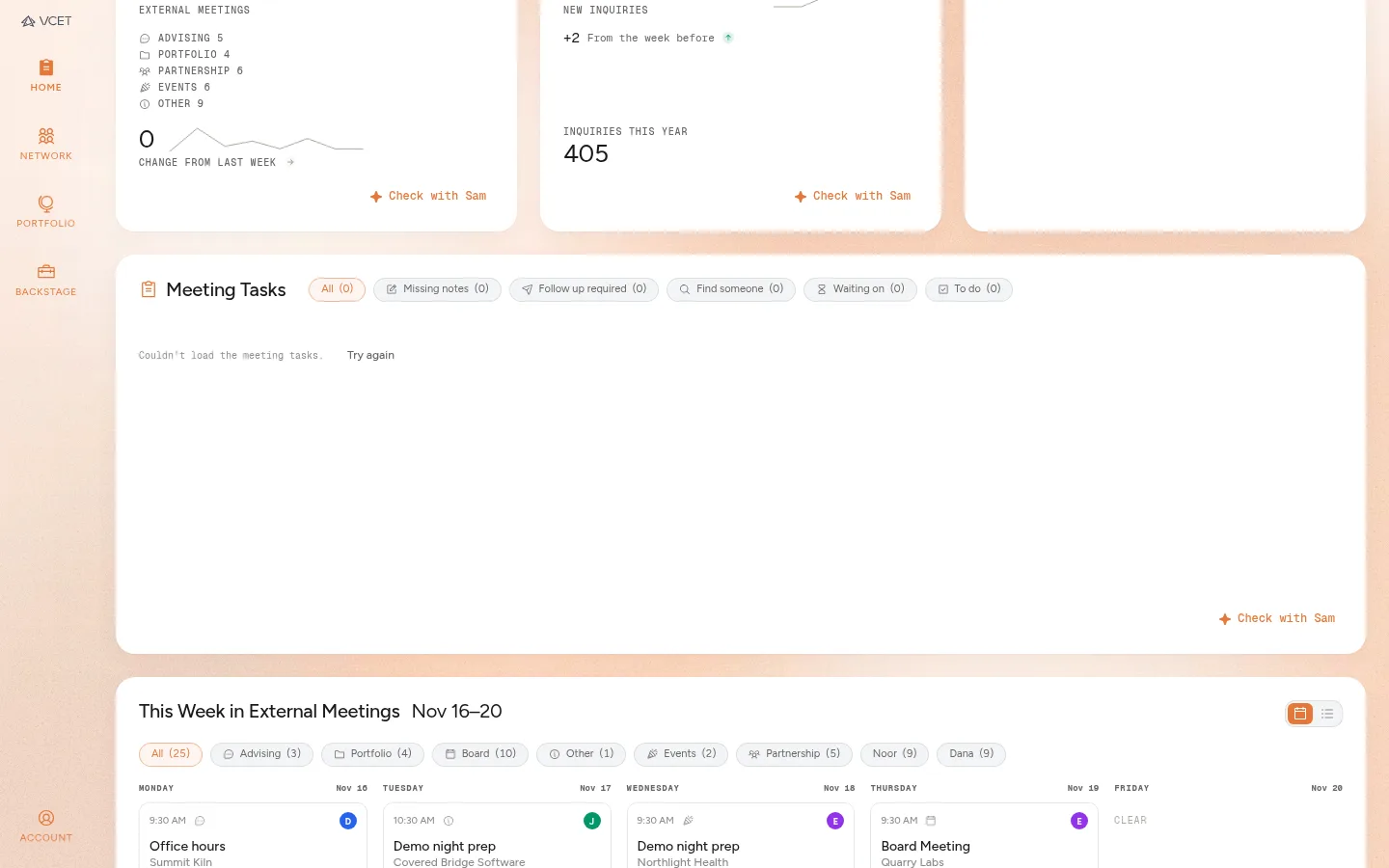
Production prioritized Monday briefings and pre/post-meeting emails running scale-to-zero inside VCET's own Google Cloud organization.
Scale-to-zero Cloud Run & Firebase inside VCET's org
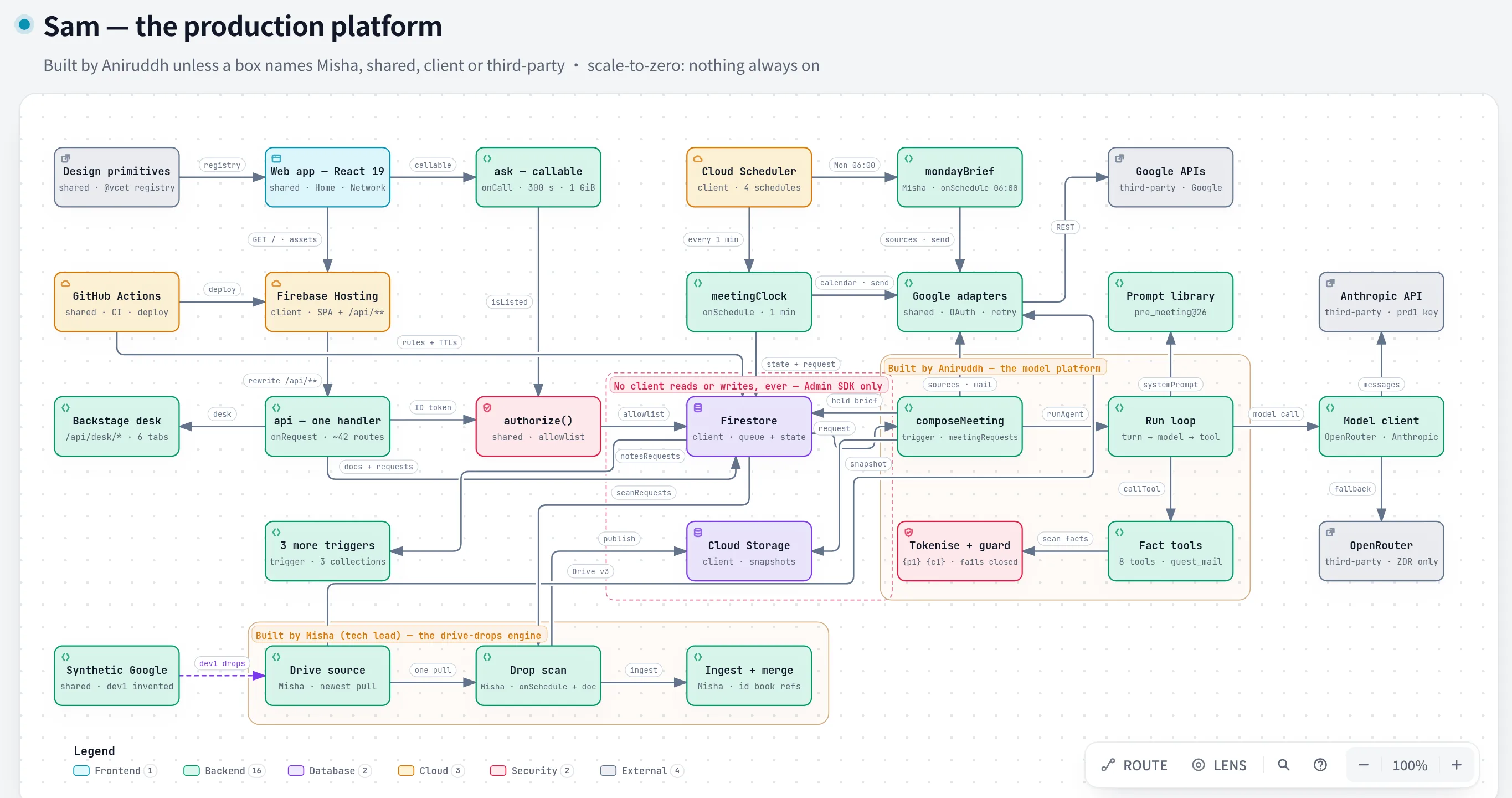
Archify architecture diagram with module ownership across Monday briefings, meeting email nudges, and Ask.
Backstage: building data-blind with simulated worlds
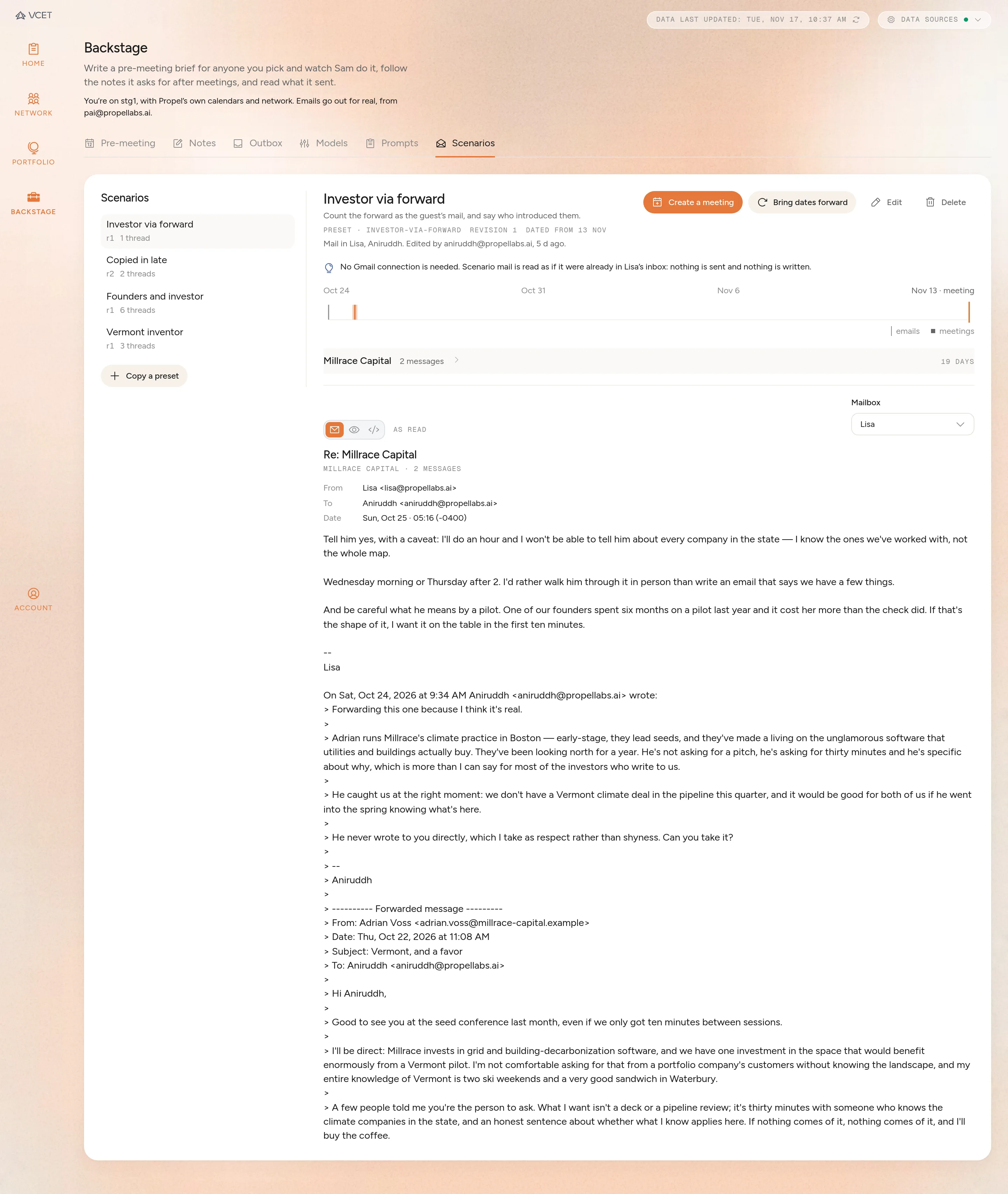
Because the team could not inspect VCET's live emails or contacts, Backstage simulated mail timelines, calendars, outbox previews, and versioned prompts across 8 realistic scenarios.
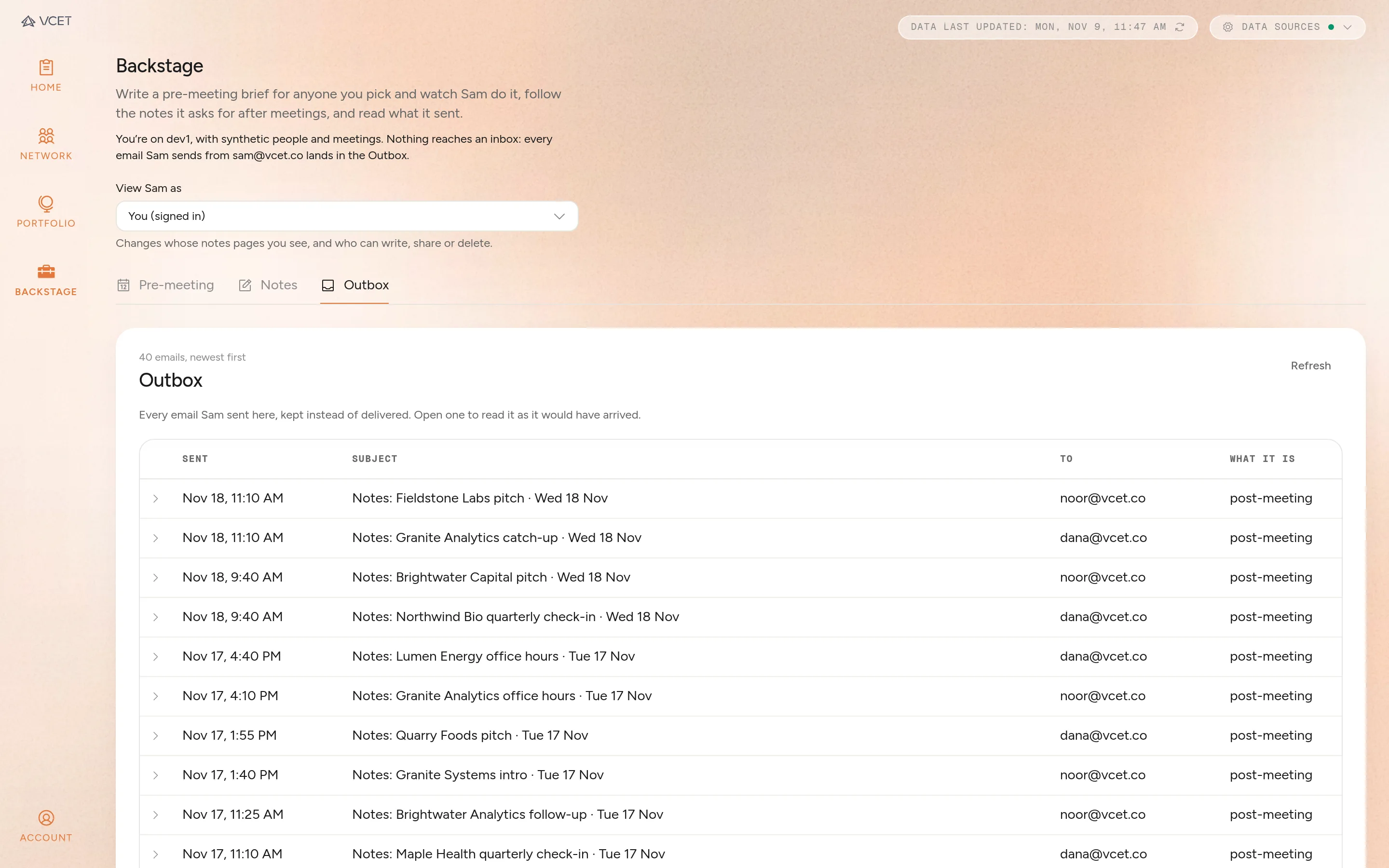
Pre-Delivery Inspection
Simulated timelines, prompt library, and Outbox inspector
Without access to VCET's real Gmail or HubSpot data, prompt regressions could silently ship bad meeting prep.
Backstage let the team anchor 8 multi-week scenarios to test dates, swap models, edit versioned prompt manuscripts, and inspect every generated Outbox email before delivery.
- 8 realistic multi-week VC scenarios with simulated mail & calendar threads.
- Versioned prompt manuscript console and model selector.
- Outbox preview verifies tone, grounding, and links prior to production rollout.
Backstage simulation and eval harness
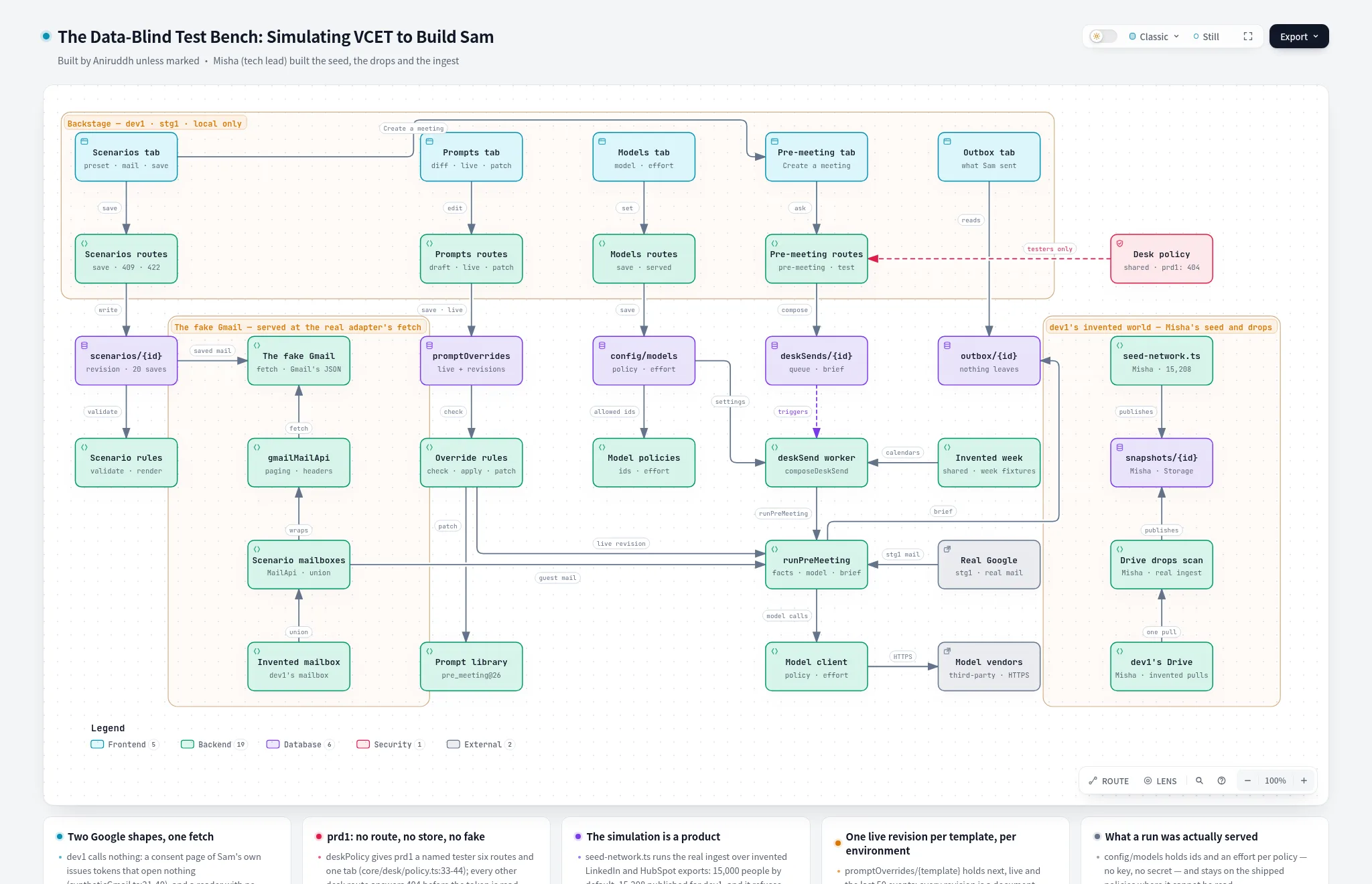
Isolated fixture worlds feeding the same production agent runtime and outbox checks.